
How to Check Criminal History in Marquette
A Marquette records search works best when it starts with the event and follows the record’s custodian. Police hold incident, arrest, and crash reports they created. The county sheriff holds local booking and custody material. The 96th District Court and 25th Circuit Court hold the filed case, hearings, plea or trial result, and sentence. Michigan State Police then maintains the reportable statewide criminal-history segments through ICHAT.
- Contact Marquette Police for a city incident, arrest, or crash report and give the report number when known.
- Submit a police FOIA request by email or at the city counter when the desired existing record is not otherwise available.
- Search MiCOURT or the Marquette court calendar for the filed case, then ask the clerk for the official file or certified disposition.
- Call the Marquette County Sheriff for recent custody and use county FOIA for releasable booking material because no public jail roster was verified.
- Use ICHAT for Michigan’s public statewide reportable history after checking the more direct city and court sources.
No one step replaces the rest. A police report explains the event from the agency’s file. A booking record tracks intake. The court file states the authorized charge and final outcome. ICHAT may summarize reportable Michigan segments, but it omits warrants, juvenile matters, federal, tribal, traffic, other-state, and some local misdemeanor records.
Marquette Police Records Use Two Queues
Police records and general city records use separate routing even though both lead to offices at 300 W. Baraga Ave. Send a request for a Marquette Police incident, arrest, or crash record through the city’s police FOIA channel. General city material goes to the City Clerk. The clerk can be reached at 906-228-0430 or clerk@marquettemi.gov, while the police department uses 906-228-0400 and police@marquettemi.gov.
This split prevents a common delay. A requester seeking a police narrative should identify it as a police FOIA matter instead of sending a broad request for “city records.” A request form is useful, but Michigan law does not make that form the only valid way to ask. The city accepts submission by email or in person. The requested document must already exist. FOIA gives access to existing nonexempt records; it does not require staff to create a new summary, answer a research question, or combine data into a new report.
Note: Describe the record, date range, place, and report number if known so staff can identify the existing city file without guesswork.
The Marquette Police Department
The Marquette Police Department operates at 300 W. Baraga Ave., Marquette, MI 49855. Its nonemergency number is 906-228-0400, and the department is staffed around the clock. The agency creates the first city record for calls, reported incidents, investigations, arrests, traffic enforcement, and crashes. Those records remain distinct from the county booking file and the court docket that may follow.
A report request should state what kind of record is sought. An incident narrative, arrest sheet, supplemental report, crash record, photograph, or audio file can involve different review and redaction work. Marquette may withhold or redact protected personal identifiers, victim information, juvenile material, and content covered by an active-investigation or other lawful exemption. Significant staff time and resources may be billed, and the city may request partial payment under its FOIA process.
Crash reports have a narrower path. The police department says they become available online within a few days when the crash date and report number are used. A person who lacks the complaint number may call Marquette Police for it without charge. A crash record is not the same as a criminal case, so a court search should only follow when a citation or charge actually reached the court.
Marquette Criminal Records Request Choices
The Marquette public-record request form lets a requester define both the record and the desired delivery. City-use fields track the request number, date, and receipt channel. Requester fields collect identity, address, and contact details. The central description box is where a police report number, incident date, location, and exact category of material can be stated. Additional sheets may be used if a precise description needs more space.
| Form Area | Marquette Options |
|---|---|
| Requested Access | Copy, certified copy, record inspection, or subscription |
| Delivery | Pickup, onsite copies, mail, email, or city digital media |
| Receipt Channel | Email, fax, or other electronic method |
| Record Description | Long text with added sheets when needed |
| Extension Consent | Date and signature for a nonstatutory extension |
| Requester Approval | Signature and date |
Inspection can make sense when a broad Marquette file needs review before copies are chosen. Email is often a practical choice for releasable digital records. A certified copy should be requested only when that form of authentication is needed. For a final criminal disposition, certification normally comes from the court clerk rather than the police department because the clerk maintains the official case outcome.
Arrests and Bookings in Marquette
A city arrest can create at least four separate records. Marquette Police creates the incident and arrest report. The Marquette County Sheriff creates the booking and custody entry. The prosecutor and court create charge and case records. Michigan State Police receives the reportable arrest, prosecutor, and judicial segments that build the state history. The initial police allegation may change before filing, and a booking label never proves guilt.
No official Marquette city jail roster or arrest blotter was verified. No official county jail roster was found either. The local fallback is direct: ask Marquette Police for its report, call the sheriff at 906-225-8435 for recent custody, request releasable booking material through county FOIA, and use MiCOURT after a case is filed. The sheriff is at 236 W. Baraga Ave., close to the city police address but responsible for a different record.
The arrest-to-court transition can take time. District Court records arraignment, bond, and the filed charge. An ordinary misdemeanor stays there through disposition. A felony begins in District Court and moves to Circuit Court only after bindover. The complete Marquette County arrest-record process covers the county booking and agency routes in greater depth.
Marquette Police Records and Parking
Not every contact with Marquette Police belongs in criminal history. The city’s annual overnight street-parking ban runs from November 1 through April 1, from 1 a.m. to 6 a.m. A parking citation created under that rule is a local enforcement record. It should not be described as a county booking, a state criminal-history entry, or proof of a criminal conviction.
This local rule is a useful test for choosing the right source. Begin with Marquette Police when the record concerns a city citation or enforcement event. Use the court only if the matter was filed there. Check ICHAT only for its public reportable Michigan history. Keeping those layers separate prevents a routine city record from being overstated and keeps a criminal case from being reduced to the first police label.
Marquette Municipal Court Records
Marquette has no municipal court. The heading describes the city-level question, but the actual court custodian is the county court system. City ordinance matters, civil infractions, and ordinary misdemeanors route to 96th District Court. Felonies also begin there for the early stages, then move to 25th Circuit Court after bindover. This is why a search for a “Marquette municipal court” can miss the real docket.
| Court Name | 96th District Court for city-level and preliminary matters; 25th Circuit Court after felony bindover. |
|---|---|
| Case Types Heard | Ordinance matters, civil infractions, ordinary misdemeanors, felony arraignment, and felony preliminary proceedings. |
| Case Lookup Channel | MiCOURT Case Search, the Marquette combined calendar, Michigan ePAY for eligible payments, and the clerk. |
| What the Record Shows | Case number, filed charge, register of actions, hearings, disposition, sentence, and financial entries as available. |
| Official Copies | Ask the clerk at 234 W. Baraga Ave.; copy and certification fees were not located in the research. |
Online court information is not the official record. Some participating courts apply a seven-year criminal sentence filter. Older entries, restricted records, and some documents may not appear online. Bring the case number to the clerk when possible and request the file or certified disposition needed, rather than relying on a calendar entry alone.
Marquette ePAY Criminal Case Routes
Michigan ePAY supports searches for eligible civil-infraction and misdemeanor payments in participating district courts. Select Marquette County and Marquette D96 before using a name, case, license, or plate route. ePAY is a payment tool, not a complete Marquette criminal-history database. A missing payment record does not establish that no ticket or case exists, and downtime does not extend a due date.
| Search Route | Fields |
|---|---|
| Court Selection | County dropdown and court dropdown, including Marquette D96 |
| Name and Case | Last name plus ticket or case number |
| Name and Birth Date | Last name plus birth month, day, and year |
| Driver License | License number and state |
| License Plate | Plate number and state |
The official ePAY search is the source for the captured Marquette court-payment interface.
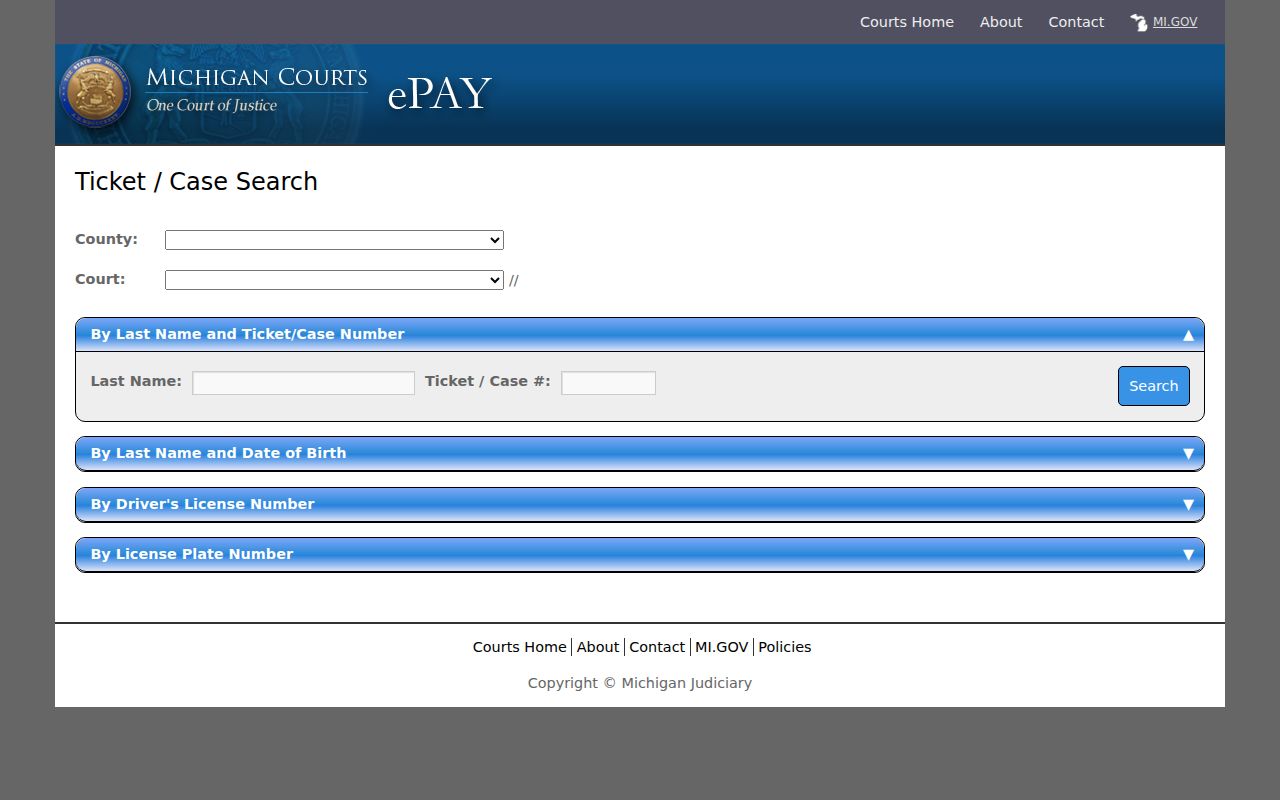
The image shows why court selection comes first and why the result must be checked against MiCOURT or the clerk for full case context.
Where Marquette Records End Up
Marquette Police does not own every later part of a city case. After an arrest, the sheriff controls booking and custody information. The prosecutor may authorize a different charge from the one named at arrest. District or Circuit Court then reports the judicial outcome. For a reportable event, those segments reach the Michigan State Police Criminal Justice Information Center.
Record flow: Marquette Police › Marquette County Courts › Michigan State Police Criminal Justice Information Center
That flow explains both delay and mismatch. A recent Marquette police report may exist before MiCOURT lists the case. A court dismissal may not yet appear in a state result if reporting is incomplete. When correcting a record, start with the source of the wrong segment: police for arrest data, prosecutor for charge data, or court for disposition data. The source verifies the event before CJIC changes the statewide record.
Marquette Criminal Case Terms
A few Michigan terms show when a Marquette case changes courts or changes legal status. Reading them correctly keeps the police event, filed allegation, and final outcome apart.
- Arraignment
- The first formal court appearance addressing the charge, rights, plea, and often bond.
- Preliminary Examination
- A District Court probable-cause hearing in a felony matter.
- Bindover
- The transfer of a felony from District Court to Circuit Court for further proceedings.
- Disposition
- The court’s outcome, such as conviction, acquittal, or dismissal.
- High-Court Misdemeanor
- A Michigan misdemeanor label with more-than-one-year exposure and felony-like procedure.
A dismissal is not a conviction, and an arrest is not a disposition. Use the court register and certified record when the exact result matters.
Public Access Rules
Police and city files use Michigan FOIA, while judicial files follow court-record rules. Neither route makes every record public. Marquette may redact protected identifiers, victim details, juvenile material, and information covered by a valid investigation exemption. Set-aside records and nonpublic registry information also remain restricted. A blank public search only describes what that search returned.
Key Statutes:
Michigan Freedom of Information Act, MCL 15.231 to 15.246 gives a written request and response process for nonexempt public-body records.
MCL 28.242 requires reportable arrest and biometric information to reach the state repository.
MCL 28.242a governs dissemination and authorized access to Michigan criminal-history information.
Michigan Court Rule 8.119 controls court-record maintenance, inspection, and restriction.
Use the city police FOIA route for a Marquette police record, the clerk for the court file, and ICHAT for the state’s public repository product. Those channels overlap in subject matter, but they are not substitutes.
Marquette Criminal Records Fallbacks
When an online search fails, the next step should follow the custodian instead of moving to an unofficial database. Call Marquette Police for the report number or request channel. Contact the sheriff for present county custody. Search MiCOURT and the combined court calendar, then call or visit the clerk for the official record. Use ICHAT only for the public state subset and allow for exclusions or reporting lag.
For a personal Michigan record review that must include public and nonpublic state information tied to identity, the official route is fingerprint-based review through MSP CJIC. That is different from a public name search. The broader Marquette County criminal history overview explains the state and county layers without turning this city page into a county-wide repeat.