
Criminal Cases in the Marquette County Courts
Marquette County criminal court cases begin in the 96th District Court when the matter is a misdemeanor, citation, or felony complaint. The District Court conducts arraignment, sets initial bond, and holds the probable-cause conference and preliminary examination in a felony. A misdemeanor normally stays there through plea or trial and sentence. The 25th Circuit Court receives a felony only after bindover, which is the formal transfer following the preliminary stage. The Circuit Court then handles arraignment on the information, motions, plea or trial, judgment, and sentence.
The 96th District Court and 25th Circuit Court both operate at 234 W. Baraga Ave., Marquette, MI 49855. Call the District Court at 906-225-8250 or the Circuit Court general clerk at 906-225-8300. The District Court also has an Ishpeming branch at 215 W. Hematite Dr., 906-485-5579, but venue and service availability should be confirmed by phone. Family and Juvenile matters use restricted procedures and different terms, even though the county courts share a concurrent-jurisdiction plan.
Verify Marquette Cases After MiCOURT
MiCOURT Case Search is the official statewide discovery route for participating trial courts. Select the Marquette court when the interface offers a court choice, then search by the available party or case route. A case number is the soundest key because common names can return more than one person. Online results are not the official court record, and some courts apply a seven-year criminal sentence filter. A missing result therefore does not prove that no older file exists.
The public MiCOURT interface shows how court selection and search fields narrow the results.
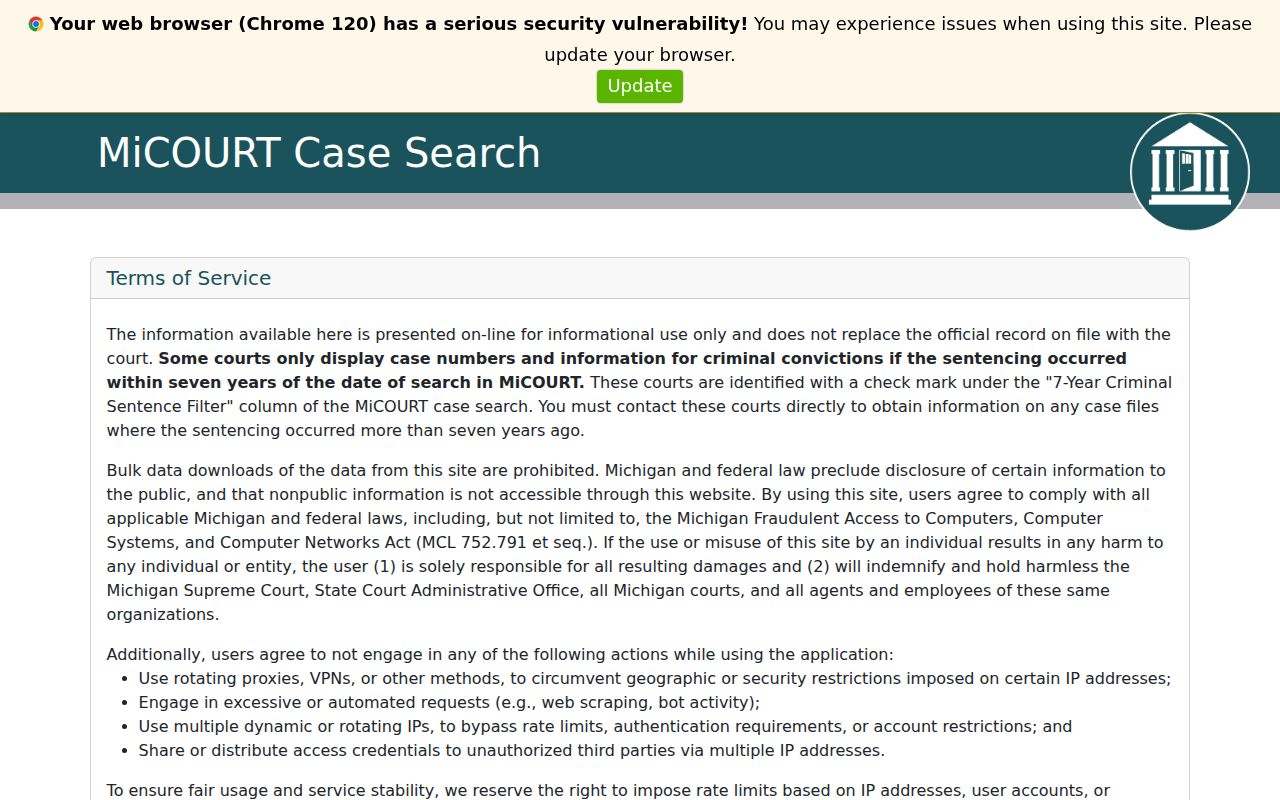
Use a result as a locator, then ask the Marquette County clerk for the register of actions, filed document, or certified disposition needed for a reliable account of the case.
| Search field | Best use | Limit |
|---|---|---|
| Court | Choose 96th District or 25th Circuit | A felony may appear in both stages |
| Party name | Find a case when the number is unknown | Confirm identity before relying on it |
| Case number | Open the most precise match | Use the full court suffix when known |
| Case details | Review docket events and status | The clerk’s file controls |
How to Search Case Records
A Marquette County criminal case search works best as a short verification chain. Start online, but do not stop at the first screen. The court calendar, case-search result, and official file have different scopes. Court records should be requested from the clerk under Michigan Court Rule 8.119, not through the county executive-branch FOIA form. No current official plain-copy or certified-copy fee was located in the research, so ask the clerk for the current charge before ordering.
- Open MiCOURT and select the relevant Marquette County court.
- Search by full case number when possible, or use the party search fields.
- Compare the court, filing year, and case suffix before opening a result.
- Check the county calendar for a coming hearing, time, and room.
- Contact the clerk for the register of actions, documents, or certified disposition.
If MiCOURT does not show an older Marquette County criminal case, give the clerk a name, approximate year, court, and any known charge. The Archives of Michigan county guide identifies justice-court criminal dockets dating from 1837 through 1915, so historical and genealogy work can require an archive route rather than a current web search.
Read Marquette Criminal Court Calendars
The Marquette County court display combines Circuit, District, and Probate schedules. It shows the calendar date, party name, hearing time, room, and case number. Observed room labels include Circuit S, Circuit N, DC Main, and Probate CR. Case suffixes include FH, FD, CZ, DC, DM, and GA. Those labels help identify the division and file, but the calendar does not display charges, dispositions, filed documents, or financial entries.
The combined Marquette court display makes the local schedule easy to scan without turning a hearing listing into a full case history.
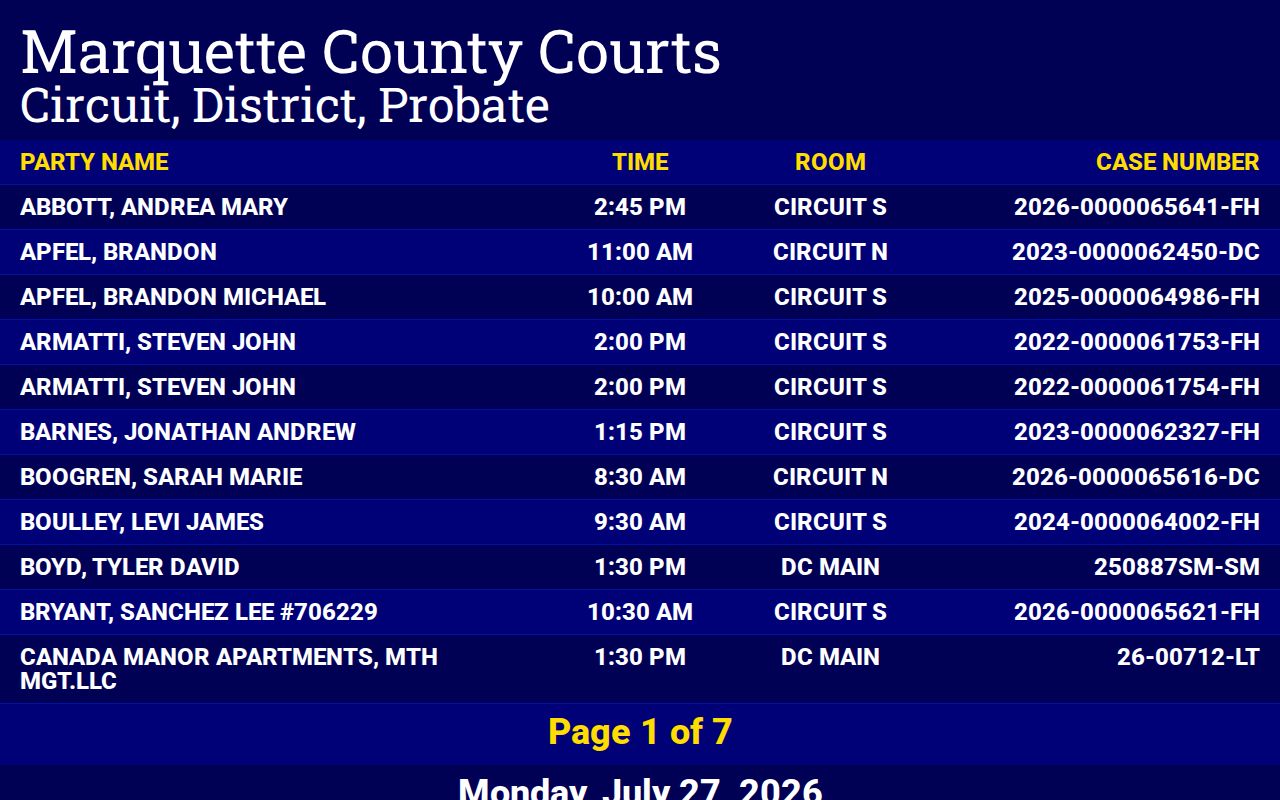
A calendar entry confirms that a proceeding is scheduled. It does not prove what happened at that hearing, and it should not be treated as the final outcome.
What the Case File Shows
The Marquette County criminal court file tracks the allegation after it reaches court. It is not a copy of the arresting agency’s narrative. The register of actions provides a chronological index, while the complaint, information, orders, and judgment explain what was alleged and decided. In a felony, the complaint begins in District Court and the information becomes the Circuit Court charging document after bindover. Prosecutor-authorized charges can differ from the label recorded at arrest.
| Case number and court | Identifies the file, division, and filing year. |
|---|---|
| Charging document | The complaint or information states the filed allegations. |
| Docket entries | The register of actions lists hearings, filings, and orders in date order. |
| Hearing dates | Show scheduled or recorded court events, subject to later change. |
| Disposition and judgment | Records dismissal, acquittal, plea, or finding of guilt. |
| Sentence and conditions | Records the court’s terms after a conviction. |
Terms matter. A dismissal ends a charge without a conviction. An acquittal is a not-guilty result. A set-aside is a later statutory action that removes an eligible conviction from ordinary public disclosure. None of those terms means the same thing.
Marquette Felonies Change Courts
A felony file can appear to split because two courts perform different parts of the work. District Court handles the first appearance, bond, probable-cause conference, and preliminary examination. If the judge finds sufficient cause, or the defendant waives the examination, the matter is bound over to 25th Circuit Court. Circuit Court then arraigns the defendant on an information and handles pretrial motions, discovery disputes, plea negotiations, trial, and sentence.
A high-court misdemeanor can follow a felony-like route because Michigan uses that label for some offenses punishable by more than one year. The word “misdemeanor” alone does not establish that the whole file remains in District Court. Check the court name and current case number. When the question concerns the arrest that preceded the filing, the separate Marquette County arrest history route points to the arresting agency and sheriff rather than the clerk.
Stages of a Criminal Case
Marquette County criminal proceedings move in a defined order, but not every case reaches every step. A misdemeanor may resolve in District Court. A felony may end before bindover, resolve by plea in Circuit Court, or proceed to trial. The register of actions is the best timeline because it records what actually occurred in the specific file.
Case flow: Charges Filed › Arraignment › Pretrial › Plea or Trial › Disposition › Sentencing
“Disposition” is the outcome of a charge. It can be a conviction, acquittal, dismissal, or another authorized result. “Sentence” follows a conviction and states the consequence imposed. Reading only the first charge line can miss amendments, dismissed counts, and the ultimate judgment.
Federal Cases Filed in Marquette
Federal criminal cases are not Marquette County court files. Marquette lies in the Northern Division of the U.S. District Court for the Western District of Michigan. The federal courthouse is in Room 330 of the Federal Building, 202 W. Washington St., and its phone is 906-226-2021. Search federal dockets through PACER rather than MiCOURT.
PACER publishes its current access and fee policy. Registration is required, access is generally billed by the page with a per-document cap, and quarterly charges at or below the stated waiver threshold are waived.
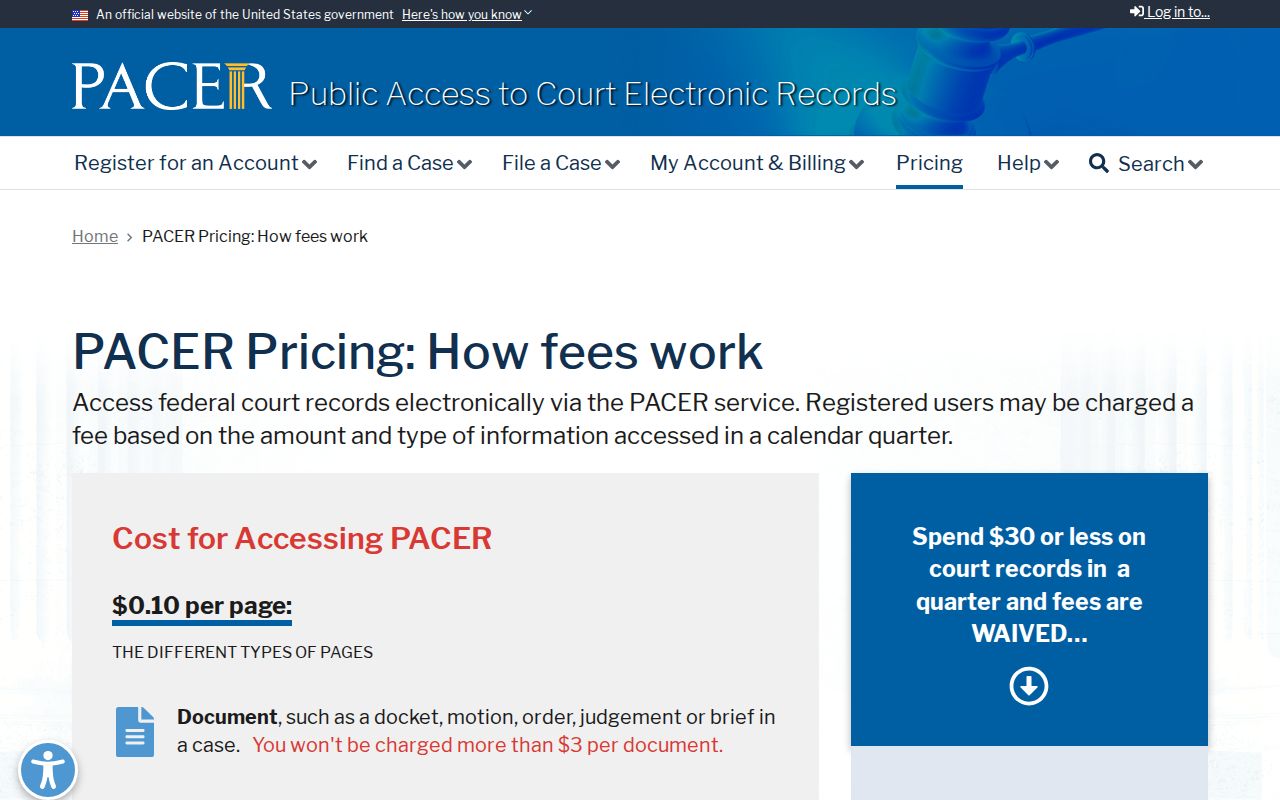
This federal channel belongs beside, not inside, a Marquette County criminal case search because MiCOURT does not cover federal prosecutions.
Access & Restrictions
Michigan Court Rule 8.119 governs the maintenance, inspection, and restriction of court records. Public access does not remove every limit. Juvenile files, victim information, protected personal identifiers, and records made nonpublic by a set-aside or another order can be withheld or redacted. Online views can also omit material that remains available through a lawful request to the clerk.
Michigan FOIA governs many public-body records, but it is not the route for the judicial case file. Ask the Marquette County court clerk for a court document. Ask the arresting agency for an incident report. Use MiCOURT to find a case, not to certify it. If an expected disposition is absent, verify the judgment with the clerk before asking Michigan State Police to correct the judicial segment in ICHAT.
Older Marquette Criminal Dockets
Marquette County’s court record reaches well beyond the online index. The present sandstone courthouse dates to the early twentieth century, and the Archives of Michigan guide lists older justice-court criminal dockets. For a historical search, begin with the person’s full name, approximate year, place, and court level. Then ask the clerk whether the record remains local or has moved to archival custody.
Online absence may reflect age, a display filter, a restricted file, or a mismatch in the search terms. It is not a sound basis for claiming that a case never existed. Genealogy research is strongest when the calendar or index entry is paired with the original docket, judgment, or certified clerk response.