
Arrest History in Marquette County
Marquette County arrests can originate with the Sheriff, Marquette Police, Ishpeming Police, Negaunee Police, the Michigan State Police Negaunee Post, Northern Michigan University Police, township police, or Michigan Department of Natural Resources conservation officers. Each arresting agency creates and retains its own incident or arrest report. If custody follows, the Marquette County Jail creates the booking record. Fingerprints for a reportable arrest begin a separate state record at the Michigan State Police Criminal Justice Information Center.
These records do not prove the same facts. An incident report describes the agency response and investigation. A booking record shows intake into custody. The court file shows what the prosecutor charged and what the judge decided. ICHAT shows only the public subset of reportable Michigan criminal history. A full search must follow the event across those custodians without treating the initial allegation as the outcome.
No Marquette County Booking Roster
No official public county inmate roster, daily booking log, or arrest blotter was verified for Marquette County. The useful local path starts with the jail phone at 906-225-8435. Ask whether the person is in current custody and what identifying facts the office needs. For releasable booking documents, use the county FOIA route and name the Sheriff as the department. A commercial jail page is not a substitute for an official roster.
The Sheriff and Jail share 236 W. Baraga Ave., Marquette, MI 49855. A person may be transferred when the local jail is full, so a custody check should ask whether a qualifying detainee was moved to another Upper Peninsula facility. The criminal case remains in the Marquette County court even when physical custody changes counties.
Marquette County Sheriff
236 W. Baraga Ave.
Marquette, MI 49855
906-225-8435
Call for recent custody. Use county FOIA for releasable booking or sheriff records that are not posted online.
How to Look Up Marquette County Arrests
A channel-complete search begins with custody and moves toward the final disposition. Names alone can match the wrong person, so use a date of birth, incident number, booking number, case number, date range, and arresting agency when the office accepts them. Give each custodian a focused request for an existing record rather than asking it to research or explain the event.
- Identify the arresting agency. If it is unknown, call the Marquette County Jail for recent custody and transfer information.
- Ask that agency for the incident or arrest report, using the report number or a narrow date, time, and location.
- Request releasable booking material from the Sheriff through the county FOIA form when no public roster answers the question.
- Search MiCOURT for arraignment, bond, filed charges, and the later disposition.
- Run ICHAT later for the public statewide repository segment, allowing for reporting lag and product exclusions.
- Use VINELink for an enrolled custody notification and OTIS only after MDOC custody or supervision begins.
The court record carries the most reliable outcome. A booking label can change when the prosecutor authorizes a different charge, and a filed charge can later be dismissed or amended. Follow the related Marquette County criminal court case when the question moves from custody to guilt, dismissal, sentence, or acquittal.
Marquette Arrest Agencies and Routes
The narrative belongs to the agency that made the arrest. County FOIA cannot produce a Marquette Police report, and a city police office cannot supply a Sheriff booking file it does not hold. The jurisdiction may turn on where the event occurred, including a city, township, campus, highway, forest, or state land.
| Agency | Official records route |
|---|---|
| Marquette County Sheriff | County FOIA; 236 W. Baraga; 906-225-8435 |
| Marquette Police | Police FOIA; 300 W. Baraga; 906-228-0400 |
| Ishpeming Police | City FOIA; 100 S. Lake; 906-486-4416 |
| Negaunee Police | Police form or email; 319 W. Case; 906-475-4154 |
| MSP Negaunee Post | Michigan State Police public-record request |
| NMU, township, or DNR officer | The university, township department, or state departmental FOIA route |
Ask for the incident narrative, arrest sheet, supplements, audio, photographs, or another existing record category only when it fits the event. A broad request for “everything” can increase search and redaction work.
What an Arrest Record Shows
Marquette County booking material may contain standard intake fields, but no official public profile was available to confirm every field released locally. The safest approach is to request the specific existing record and let the Sheriff apply Michigan disclosure rules. Medical, security, juvenile, victim, and protected identifier details can be withheld or redacted.
| Incident or report number | The arresting agency’s locator for its narrative. |
|---|---|
| Arrest date, time, and place | Describes the custody event, not the final case outcome. |
| Booking number and time | The jail’s intake locator and processing time. |
| Arresting agency | Identifies the office that holds the police narrative. |
| Alleged charges | Initial labels that may change after prosecutor review. |
| Fingerprint transaction | Links a reportable event to the state identification segment. |
| Bond or release status | Shows current custody conditions when the record provides them. |
| Photograph | Created for identification; public availability was not verified. |
Do not infer guilt from a booking photograph or arrest charge. Marquette County has no verified official mugshot gallery, and no arrestee photographs or names are republished here.
Marquette Arrests Reach State Records
An arrest creates a chain rather than a single file. The arresting agency records the event. The jail creates custody, property, identity, fingerprint, and booking entries. Under MCL 28.242, a reportable arrest sends fingerprint and arrest information to the Michigan State Police Criminal Justice Information Center, with an arrest card forwarded to the FBI. The prosecutor adds authorized or changed charge data, and the court clerk later reports the judicial disposition.
The official Michigan arrest-reporting statute page shows the rule behind the state arrest segment.
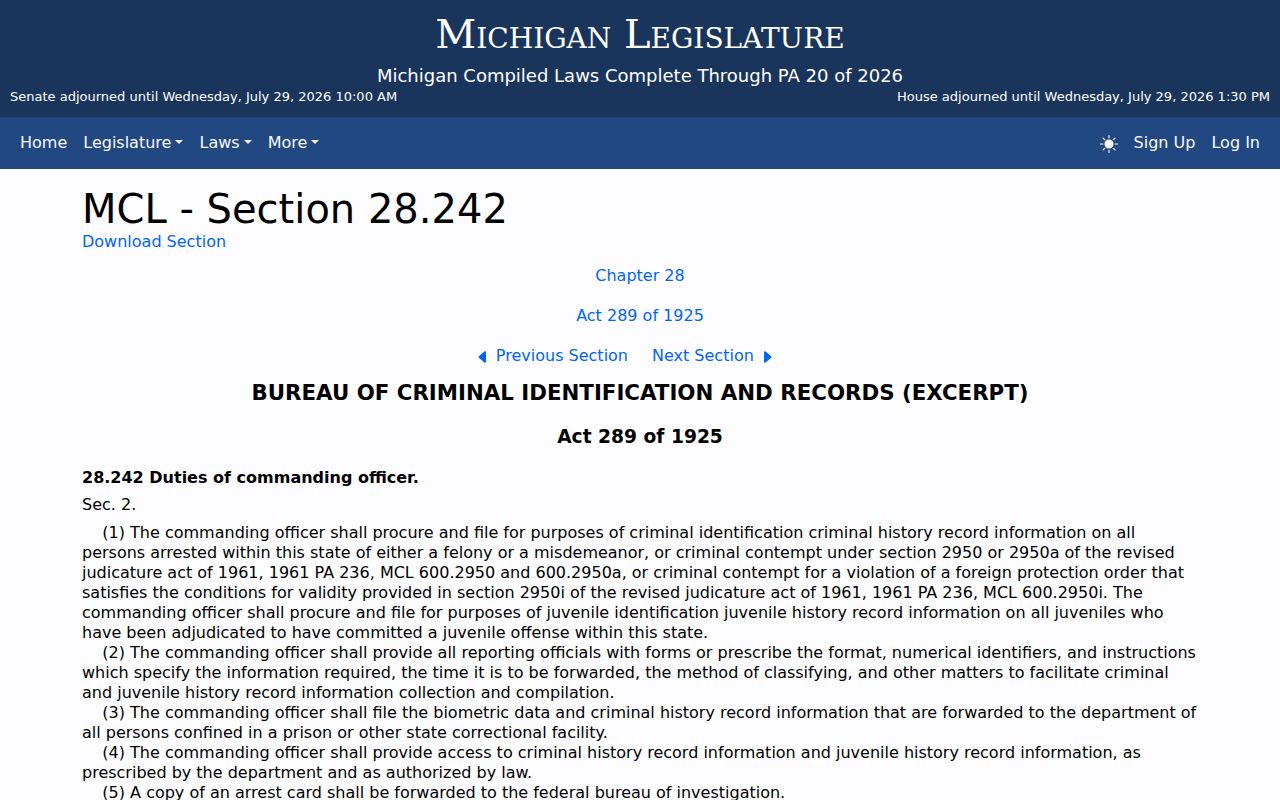
This segmented design explains why the police label, prosecutor charge, and court outcome can differ without any record necessarily being false.
Recent Arrests and Booking Logs
Because no official Marquette County booking log was verified, selected agency press items and social posts must not be treated as a full arrest history. They may describe a notable event while omitting routine bookings. Absence from those sources proves nothing. Call the jail for recent custody, request an existing booking record through FOIA, and check MiCOURT once the case is filed.
VINELink can provide custody or release notice when a record is enrolled. OTIS is a different tool for people in Michigan Department of Corrections custody or supervision, including certain people discharged within the prior three years. OTIS is not the county jail list and does not cover every recent arrest. ICHAT also omits warrants, traffic matters, juvenile records, federal and tribal cases, other-state events, suppressed records, and some local misdemeanors.
Marquette Jail Capacity and Transfers
Official county records state that the Marquette County Jail has a maximum capacity of 80. In January 2025, the county authorized transfer of up to 15 qualifying inmates to other Upper Peninsula jails when capacity required it. By that point, two people had gone to Alger County and three to Iron County. The April 2025 average daily population was 93.
Average daily population measures occupied jail days, not unique arrests and not a crime rate. One person can contribute many days. A transfer changes where someone is held, but it does not move the Marquette County criminal court file. Searchers should ask the Sheriff about transfer status and use the issuing court for bond, charges, and case outcome.
Arrests vs Convictions
An arrest records a custody event based on an allegation. A conviction is a court judgment of guilt. Between them, the prosecutor can decline, add, or change charges, and a court can dismiss a count or enter an acquittal. Compare the booking record with the disposition before describing what occurred.
| Arrest record | Conviction record |
|---|---|
| Created by the arresting agency and jail | Created by the court and reported to MSP |
| Shows that arrest or booking occurred | Shows a judgment of guilt |
| Lives with the agency and Sheriff | Lives in the clerk’s file and repository segment |
| May end in release, no charge, dismissal, or acquittal | Leads to judgment and sentence, subject to appeal or set-aside |
Note: An arrest is not proof of guilt, and the final court disposition controls how the case ended.
Correct a Marquette Arrest Segment
A mistake should be sent to the office that created that segment. Ask the arresting agency to review incorrect arrest information. Ask the prosecutor about an authorized charge entry. Ask the Marquette County court clerk to verify a missing or wrong judicial outcome. Michigan State Police can update the state history after the source office corrects or confirms the event.
Michigan State Police explains personal review and correction routing. A Michigan resident can use RI-008 fingerprints for personal review, while a nonresident uses FD-258 and postal submission to CJIC.
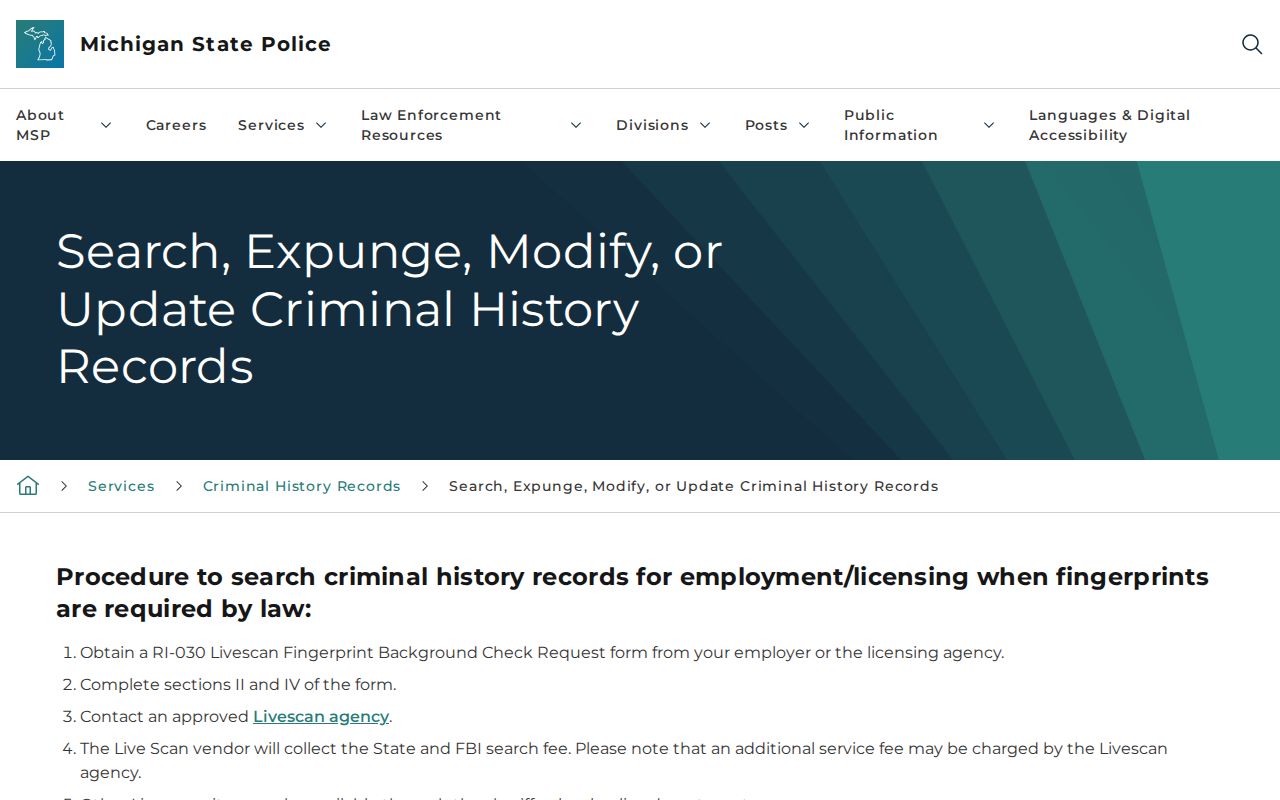
Correction changes inaccurate data. A set-aside is separate legal relief that limits ordinary public disclosure of an eligible conviction.
Request Marquette Booking Material
The County of Marquette online FOIA form is the verified county-wide fallback for releasable sheriff and booking records. Identify the Sheriff as the department. Give the incident or booking number when known, or narrow the request by date, approximate time, place, agency, and type of record. State whether inspection, electronic delivery, paper copies, or another medium is wanted.
Michigan FOIA generally calls for a response within five business days through a grant, denial, partial response, or permitted extension notice. It does not require the county to create a new report or perform research. Search, examination, redaction, copying, and mailing charges may apply, and a qualifying request can require a deposit. Judicial records must go to the court clerk instead.