
How to Check Criminal History in Marquette County
A useful Marquette County criminal record search starts with identifiers, not assumptions. Gather the full name, date of birth, any former names, and a case or report number when one is known. The spelling and birth date matter in a name-based check. A case number is even better when the name is common. Then decide whether the goal is a court outcome, a police narrative, current jail status, an official Michigan history, or state supervision information.
Marquette County has no single tool that covers all those needs. Follow the record from its source and compare the result with the next official stage:
- Search MiCOURT for a 96th District or 25th Circuit case, then note the court and case number.
- Check the combined court calendar if the question concerns a scheduled hearing, room, or time.
- Ask the clerk for the file, register of actions, certified disposition, or an older item missing online.
- Request the incident report from the arresting agency and booking material from the Sheriff.
- Use ICHAT for Michigan’s public statewide subset, and OTIS only for MDOC custody or supervision.
MiCOURT is a discovery tool, not a certified record. A calendar is narrower still. The clerk’s file controls the court outcome, while the arresting agency controls its own report.
Marquette County Records on Baraga Avenue
The Marquette County justice offices sit close together, but their criminal records remain split. The Courthouse and Annex at 234 W. Baraga Ave. house the 96th District Court, 25th Circuit Court, clerks, Prosecuting Attorney, and a local MDOC probation and parole office. The Sheriff and 80-bed County Jail are next door at 236 W. Baraga. The Public Defender is at 228 W. Baraga.
That compact layout can trip up a first search. The clerk keeps the filed charge and disposition. Police or the Sheriff keep incident material. The jail keeps booking and current-custody data. The prosecutor reports authorized or changed charges into the record chain, while MDOC keeps state custody and certain supervision data.
The Michigan Sheriffs’ Association profile for Marquette County shows the official sheriff contact used for the Marquette County booking route.
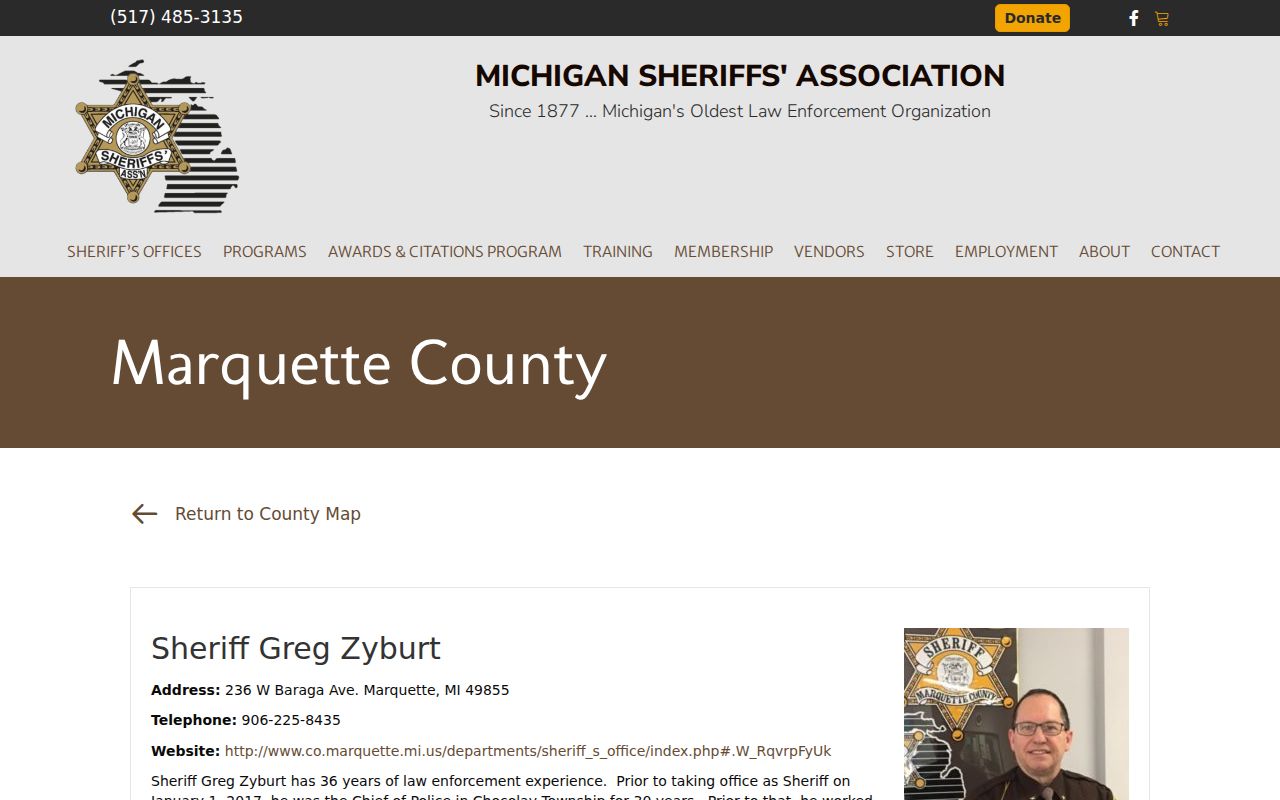
The profile anchors the Sheriff and Jail at the same place where callers confirm custody and seek releasable booking records.
Note: Call the record-holding office before a visit because current counter, screening, parking, and accessibility details were not located.
Official Michigan Background Checks
The Michigan State Police Criminal Justice Information Center maintains the state repository. Its public name-based product is ICHAT. A $10 search uses first name, last name, gender, and date of birth. It returns the public subset of reportable Michigan felonies and serious misdemeanors punishable by more than 93 days. A name match is not fingerprint-confirmed.
Personal fingerprint review is broader. A Michigan resident obtains RI-008 fingerprints from local law enforcement, then mails the card, a cover letter, and a $30 payment to MSP CJIC. MSP states a three-to-five-week time frame and includes one certified or notarized original. An added original costs $1. A nonresident uses FD-258. Statutorily authorized electronic checks instead use an RI-030 from the requesting authority and an approved Live Scan agency.
The MSP criminal-history gateway separates the ICHAT name check, personal review, correction, and fingerprint-based channels.
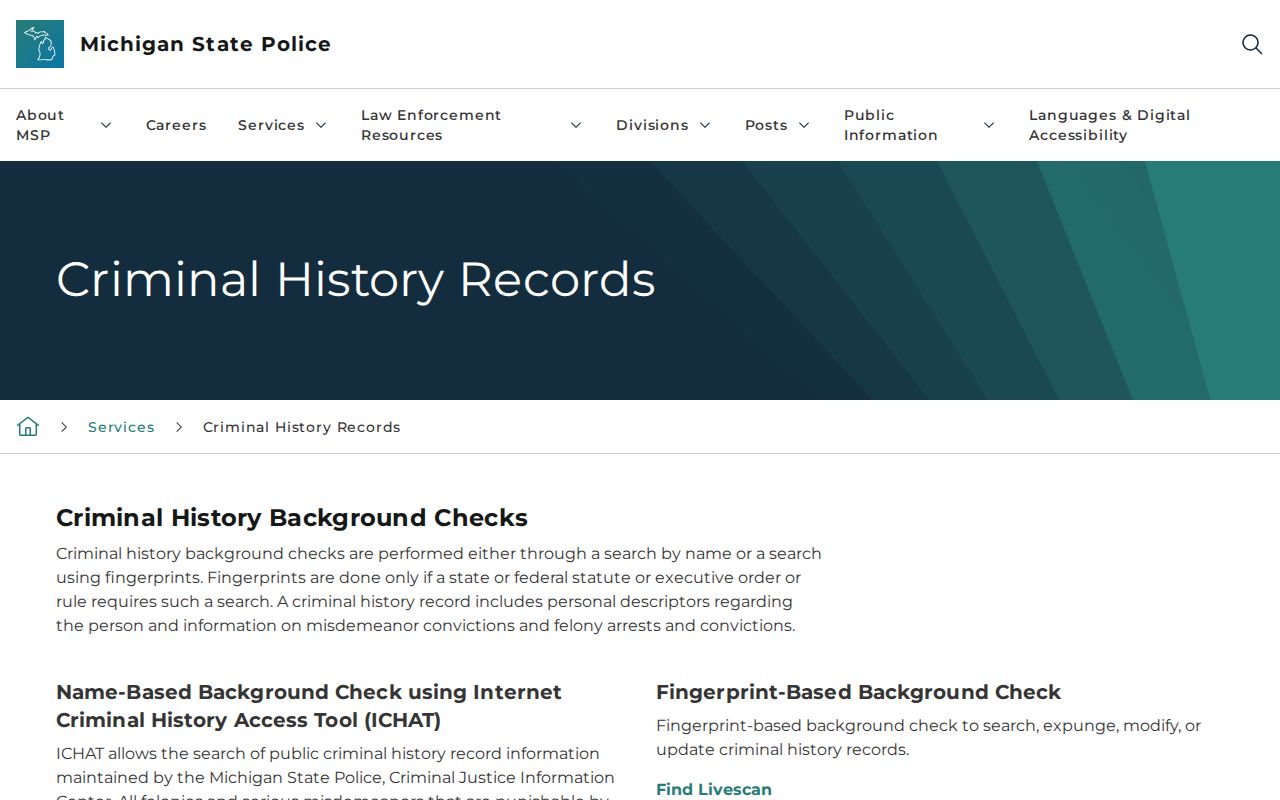
This gateway matters because the public ICHAT result and a subject’s fingerprint-based review are different products with different scope.
Marquette County ICHAT Record Limits
ICHAT is useful when the desired result is Michigan’s public repository summary. It is not a full Marquette County criminal history. It excludes warrants, juvenile and suppressed records, traffic matters, federal and tribal cases, other-state events, and local misdemeanors outside the reportable scope. A blank result means only that the submitted identifiers produced no public ICHAT record.
The search form is short, but each field helps distinguish the subject. Check the inputs before paying because the fee applies per search.
| ICHAT field | Type | Required | Use |
|---|---|---|---|
| First Name | Text | Yes | Exact identifying input |
| Last Name | Text | Yes | Exact identifying input |
| Gender | Choice | Yes | Current options appear in the live portal |
| Date of Birth | Date | Yes | Required identifying input |
If a Marquette County event is absent or wrong, correction follows the faulty segment. The arresting agency checks arrest data, the prosecutor checks charge data, and the court checks the judicial outcome before CJIC updates the state history.
Types of Criminal Records
One incident can produce several records. Their dates, labels, and level of detail may differ because each custodian records a different stage. A Marquette County arrest report describes the agency response. The jail’s booking entry documents intake. A complaint or information states the filed allegation. The clerk’s case file records hearings and the result. CJIC links reportable segments to a fingerprint-based identity.
- Arrest and incident report: agency narrative, time, place, alleged conduct, officers, and evidence references.
- Booking record: jail intake, booking number, initial charges, bond, release, fingerprints, and property entries.
- Court case file: complaint, hearings, motions, plea or trial, disposition, sentence, and register of actions.
- Warrant record: a court-issued order acted on by law enforcement, with access that depends on type and status.
- Custody or supervision record: county jail data or the separate MDOC record shown in OTIS.
The first allegation can change when the prosecutor reviews it. For that reason, use the court disposition when describing what happened, not the arrest label alone. The fuller path from booking to outcome is covered in Marquette County arrest history.
Marquette County Jail Record Fallback
No official public Marquette County inmate roster was verified. The Marquette County answer is a fallback chain, not a commercial inmate page. Call the Sheriff and Jail at 906-225-8435 for recent custody. Ask for releasable booking material through county FOIA. Search MiCOURT when a case has been filed. Use VINELink for enrolled custody notifications and OTIS only after MDOC becomes involved.
The Marquette County FOIA form can route an existing sheriff record request. Identify the Sheriff as the department. Give a narrow date range, report or booking number when known, a clear description of the existing record, and the requested delivery format. Michigan FOIA does not require the county to create a report or conduct research.
The official Marquette County FOIA request form is the verified online route for county-held records.
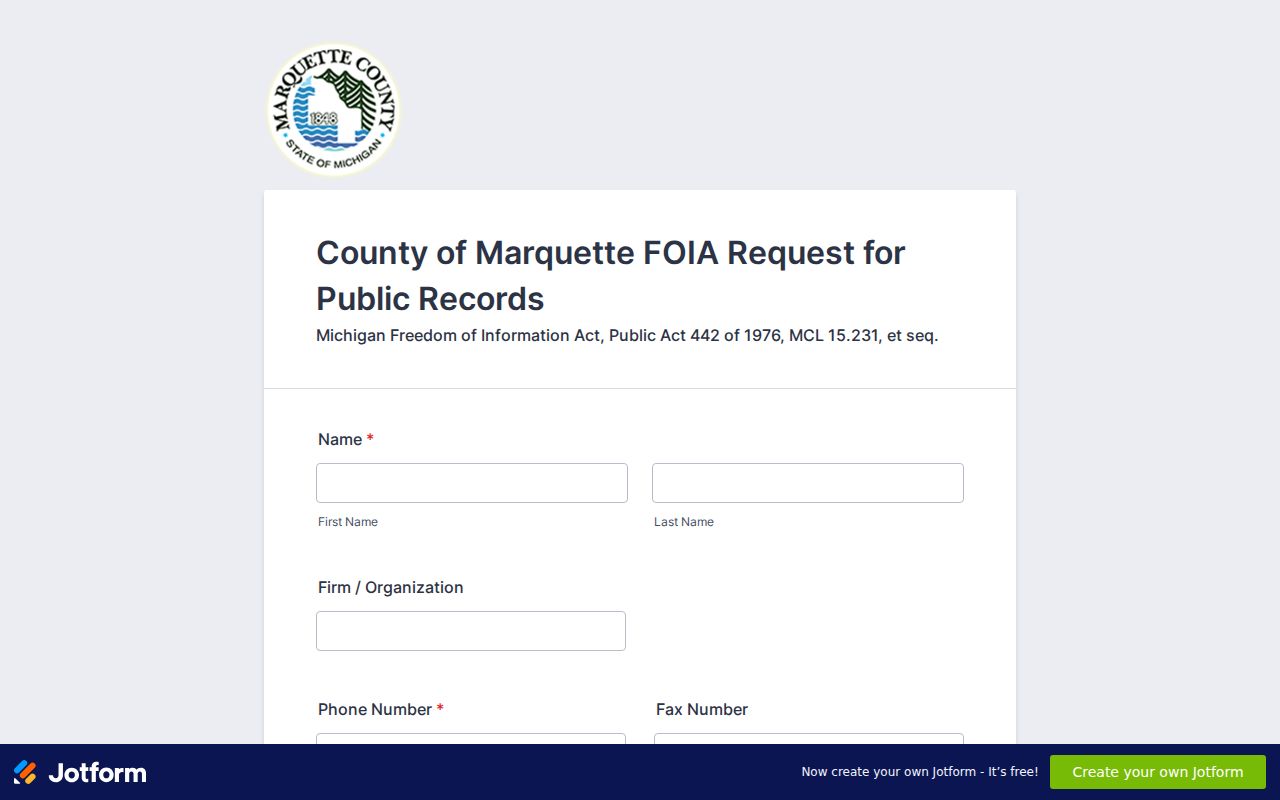
The form helps turn a broad custody question into a request for a specific booking or sheriff record that already exists.
| Channel | Best use | Main limit |
|---|---|---|
| Jail phone | Present county custody | Not the police narrative or outcome |
| County FOIA | Releasable booking or sheriff material | Redaction and lawful fees may apply |
| MiCOURT or clerk | Filed charge and disposition | Not a jail roster |
| OTIS | MDOC custody or supervision | Excludes jail-only cases |
What a Marquette County Criminal Record Shows
A repository history separates identification, arrest, prosecutor, and judicial segments. A Marquette County file may show more detail than the state summary. Compare the identifiers first, then follow the charge from arrest through authorization and final disposition. Custody and supervision may appear in OTIS rather than in the court display.
| Name & Identifiers | Legal name, aliases, birth date, descriptive data, and fingerprint-linked state or FBI identifiers when authorized. |
|---|---|
| Arrest / Booking Data | Arrest date, agency, transaction, booking number, intake time, and charges alleged at arrest. |
| Charges & Statutes | Arrest charge, prosecutor-authorized or changed charge, and the cited Michigan offense provision. |
| Disposition | Dismissal, acquittal, plea, conviction, or another judicial result recorded by the court. |
| Sentence | Custody, probation, fines, restitution, and other terms imposed after conviction. |
| Custody / Supervision Status | County jail status from the Sheriff or selected MDOC prison, probation, and parole data through OTIS. |
A high-court misdemeanor is a Michigan term that can mislead a reader. Though labeled a misdemeanor, it carries more than one year of possible confinement and follows a felony-like District-to-Circuit route. A bindover is the transfer of a felony matter from District Court to Circuit Court after the preliminary stage.
Marquette County Jail Versus Prison Records
The County Jail and Marquette Branch Prison are not two names for one facility. The 80-bed jail at the Sheriff complex holds local pretrial and shorter-term populations. Marquette Branch Prison is a separate MDOC Level I and Level V state institution. Search current county custody through the Sheriff; search state prison and selected supervision data through OTIS.
Official 2025 Marquette County records show why that distinction matters. The jail’s April average daily population was 93, above its rated capacity. Earlier authorization allowed transfer of up to 15 qualifying people to other Upper Peninsula jails when needed. A transfer changes where a person is housed. It does not move the Marquette County court file or make the person an MDOC prisoner.
The official MDOC OTIS locator explains the state custody and supervision search.
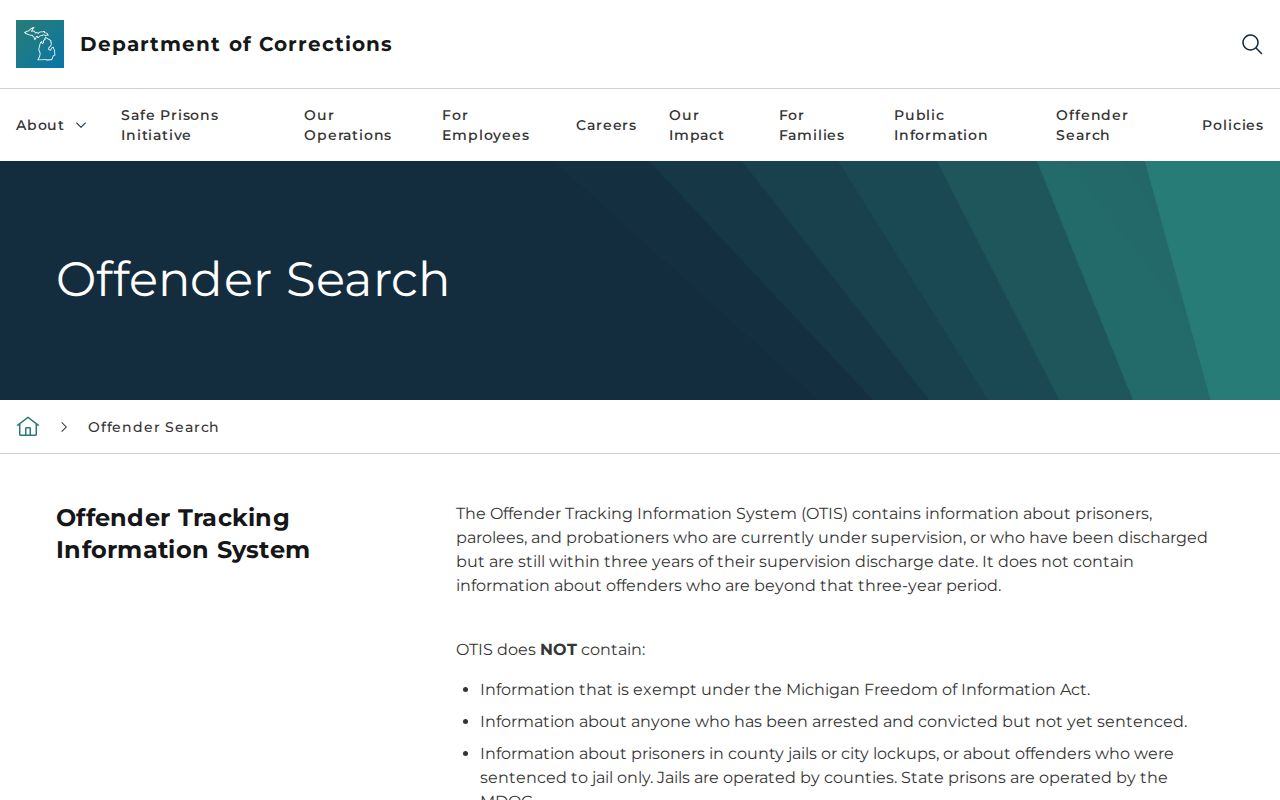
OTIS can show a state record that the county jail cannot, but it omits jail-only cases and people who have not entered MDOC supervision.
The MDOC Marquette Branch Prison profile identifies the state facility and its history.
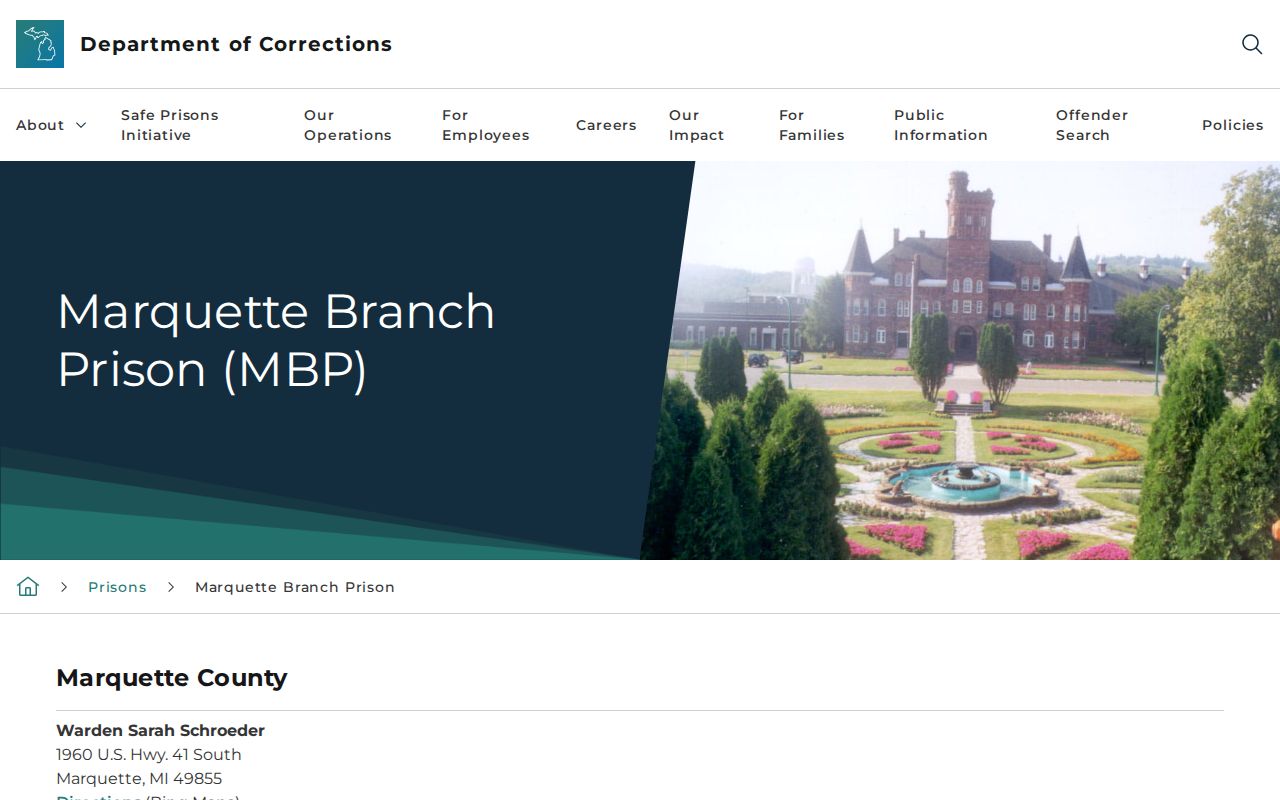
The state profile keeps a Marquette Branch Prison search on the MDOC side of the record system rather than the county jail route.
Public Access Laws
Michigan law assigns different access rules to agency, repository, court, set-aside, and registry records. FOIA presumes access to nonexempt records held by a public body, but judicial records follow court rules. A request may be granted, denied, partly granted, or extended within the statutory response framework. Search, review, redaction, copying, and mailing charges may apply.
Key statutes and rules:
Michigan FOIA, MCL 15.231–15.246 sets the request and response framework for nonexempt public-body records.
MCL 28.242 requires collection of reportable criminal-history and biometric information.
MCL 28.242a governs criminal-history dissemination and authorized access.
Michigan Court Rule 8.119 controls court-record maintenance, inspection, and restrictions.
MCL 780.621 et seq. governs application and automatic set-asides and restricted post-relief records.
FOIA does not override juvenile confidentiality, victim protection, personal-identifier redaction, a valid investigation exemption, or a set-aside restriction. Court documents should go to the clerk, not the Marquette County executive-branch FOIA form.
Marquette County Criminal Record History
The sandstone courthouse is an active record building and a Marquette landmark. Built from 1902 to 1904, it replaced Marquette County’s 1857 wooden courthouse. It became a Michigan State Historic Site in 1976, entered the National Register in 1978, and underwent a major renovation in 1982.
Its best-known cultural link is Anatomy of a Murder. The building appeared in Otto Preminger’s 1959 film, adapted from the novel by former Marquette County prosecutor and later Michigan Supreme Court justice John D. Voelker. The Archives of Michigan reaches much farther back, listing county justice-court criminal dockets from 1837 through 1915. Those records support genealogy and local-history work beyond the reach of a modern online filter.
Federal cases follow another route. The Western District of Michigan’s Northern Division sits in Marquette, and PACER is the official federal docket system. The federal court’s Marquette location page identifies the serving courthouse.
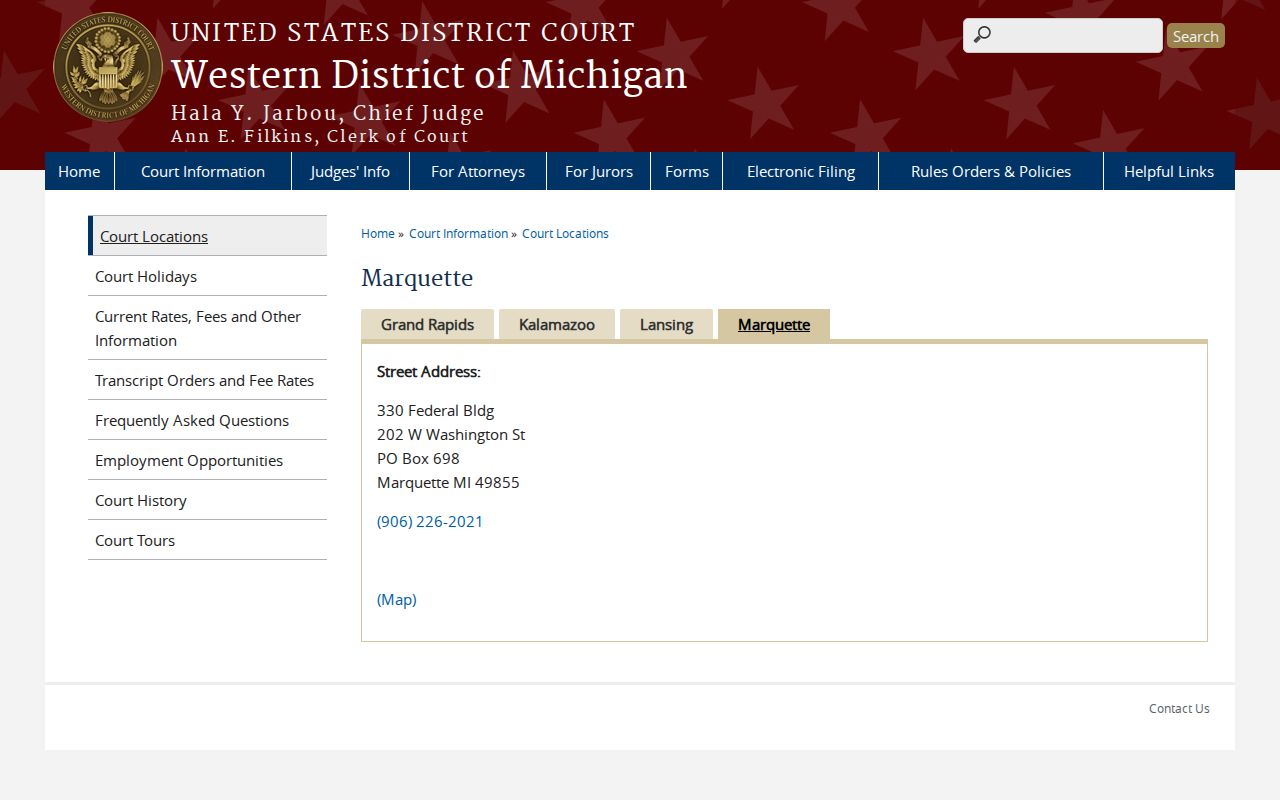
This federal source prevents a federal docket from being mistaken for a 96th District or 25th Circuit file.
Sealed, Expunged & Restricted
Michigan’s statutory record-clearing term is “set aside,” while state agencies also use “expungement.” Clean Slate is the automatic route for eligible convictions. Juvenile files, victim information, nonpublic registry data, and set-aside events can be restricted. Other items absent from ICHAT, such as federal, tribal, traffic, other-state, and some local misdemeanor records, are outside that product rather than sealed.
An application-based set-aside usually starts in the court of conviction. The applicant gets a current application, certified judgment or register of actions, and fingerprints. The packet goes to MSP CJIC with the $50 processing fee, except that juvenile applications do not pay that MSP fee. MSP states about eight weeks for processing and mailing. The court then handles the request under current law.
Automatic Clean Slate became operational in 2023. Waiting periods, numerical caps, open charges, sentence completion, later convictions, and offense exclusions all affect relief. A set-aside removes an eligible event from ordinary public disclosure, but it does not erase every authorized nonpublic government use. After relief, check the court display and ICHAT once systems have had time to update.
Marquette County Warrant Record Route
Marquette County has no verified sheriff public active-warrant database. The local Public Defender offers a distinctive bench-warrant route and advises direct court confirmation for the most accurate status. A bench warrant often follows failure to appear, failure to comply, or a probation matter. An arrest warrant comes from a probable-cause process. A search warrant may remain sealed before execution.
Start with the Marquette County Public Defender warrant route, then match the associated case in MiCOURT. Confirm the court, case number, charge, bond, and current status with the District or Circuit clerk. The published main court lines are 906-225-8250 for District Court and 906-225-8300 for the Circuit clerk. The Sheriff’s 906-225-8435 line can address current custody.
A list can lag after a warrant is issued or cleared. Resolve the matter through the issuing court and counsel. Do not assume a blank name search proves that no warrant exists, and do not rely on ICHAT because warrants are outside its public product.
Criminal Records by City in Marquette County
City police in Marquette County create their own incident and arrest reports even though county courts decide the filed cases. Marquette, Ishpeming, and Negaunee each have a distinct police or city records route. None has a separate municipal court. City ordinance, misdemeanor, and early felony matters route through the 96th District Court, with felonies moving to 25th Circuit after bindover.
Marquette Criminal History
Population 20,629 in the 2020 Census. Police records start with Marquette Police, while city court matters use the county courts.
Ishpeming Criminal History
Population 6,140 in the 2020 Census. City FOIA runs through the City Manager, and court matters may use the Ishpeming D96 branch.
Negaunee Criminal History
Population 4,627 in the 2020 Census. Police supply a records form and email route, while cases proceed through county court.
A Marquette County city arrest can therefore create a police report at city level, a booking record with the Marquette County Sheriff, and a case file at District or Circuit Court. The official statewide layer comes later through CJIC reporting. Registry searches add a separate public-safety channel through the Marquette County sex offender check.
Marquette County Probation and Parole Records
Probation and parole are not the same status. A court imposes probation as a community sentence and retains jurisdiction. The Michigan Parole Board decides conditional release for MDOC felony prisoners. MDOC Field Operations supervises felony and certain high-court-misdemeanor probationers, while lower-court misdemeanor probation follows local or District Court arrangements.
The local MDOC office is in Room 36 at 234 W. Baraga Ave., Marquette, MI 49855, with phone 906-225-8224. OTIS covers people now under MDOC supervision and people discharged within the last three years. It does not show jail-only cases, defendants who have not been sentenced, exempt material, or people discharged more than three years ago.
The MDOC Region 1 office directory provides the official Marquette supervision contact.
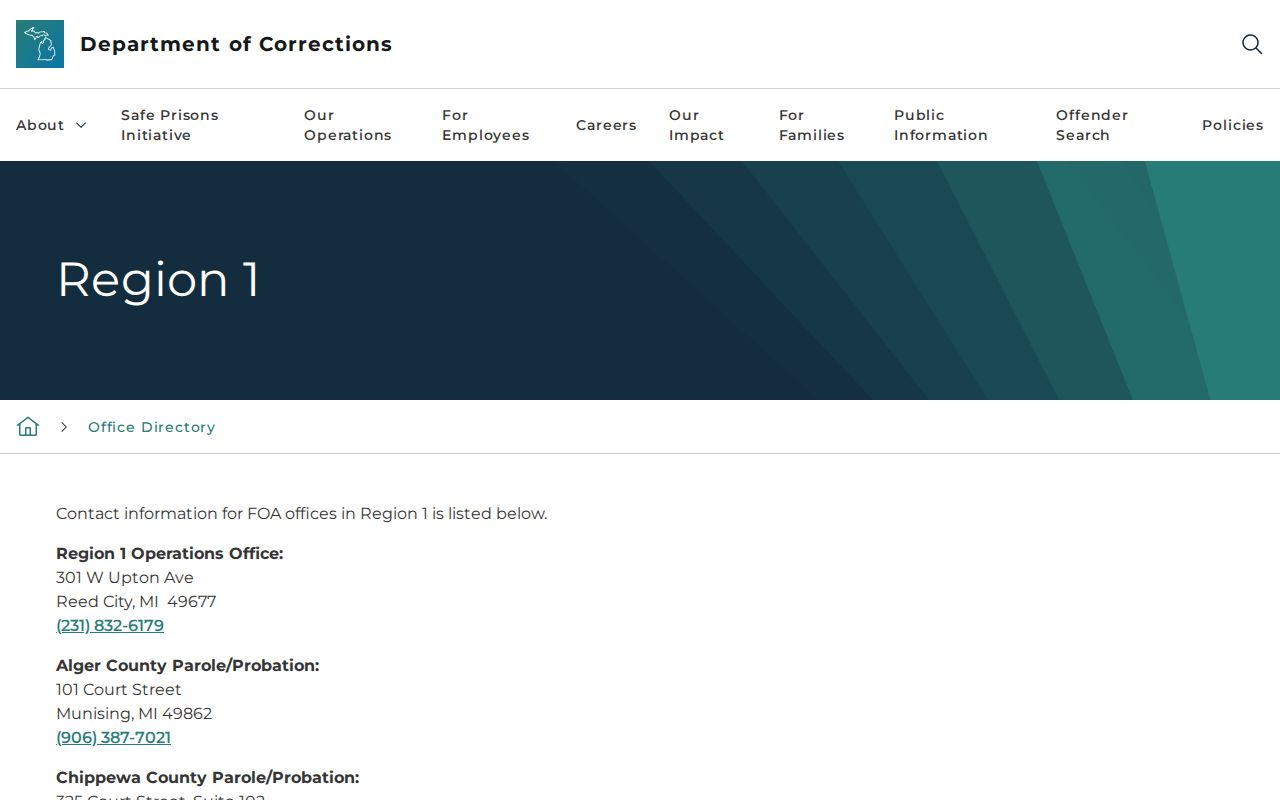
The office listing supplies the human fallback when an OTIS entry needs to be checked against the sentencing court or current supervision office.
Note: OTIS is a public locator for selected custody and supervision facts, not a full probation officer file or complete criminal history.